

Systems Design · Parsons × Bayer · 2026
Innovation Sprint
Value System
Overview
Bayer introduced Innovation Sprints as a mechanism for teams to solve problems together in five days, part of a broader shift toward Dynamic Shared Ownership (DSO), a more distributed operating model in Bayer. However, sprints were stalling. Not because the method failed, but because the value they generated — the alignment shifts, ownership clarity, and the confidence built — had no system to capture, translate, or communicate it once the five days ended. Without visible evidence, leadership buy-in eroded and participation stalled.
Through interviews across many areas of Bayer at a global level, co-creation workshops with Bayer's Innovation Team, and a series of prototype testing, the external partner studio designed the Innovation Sprint Value System. A multi-layered platform that runs across the full sprint lifecycle. It logs investment before the sprint, monitors engagement in real time during it via Zoe (Bayer's internal AI assistant), and translates everything after into audience-specific evidence: ROI dashboards for leadership, contribution summaries for participants, and retrospective data for facilitators.
Core finding
Value is not visible, not standardized, and not owned by the people involved. Innovation Sprints exist, but their value doesn't travel beyond the 5-day sprint.
Research & Synthesis
One-size Innovation Sprints
The sprint is deployed as a standardized method, but teams interpret and demand innovation differently — leading to mismatched expectations and unsatisfactory outcomes.
"Innovation sprint is designed as a universal method, but the organization requires contextualized approaches for different teams and work cultures."
Human side of Innovation Sprints
Sprints are designed for exploration, yet participants feel pressure to deliver fast outputs rather than explore ideas — limiting the critical thinking the sprint depends on.
"The effectiveness of innovation sprints is shaped not only by the method but by human factors that influence how participants engage in exploration."
Innovation Sprint in fog
Participants lack shared understanding of the sprint's purpose, value, and context before they arrive. Traditional ROI expectations conflict with exploratory work, limiting leadership support.
"Innovation sprints are introduced as a vehicle for innovation, but the surrounding organizational understanding has not caught up."
Behind the scenes
Limited trained facilitators cap execution quality and scale. Sprints often lack participants with the necessary decision-making authority. Clear outcomes fail to translate into action without defined roadmaps.
"Innovation sprints are introduced as fast innovation, but they quietly demand invisible coordination and expertise that remain largely unacknowledged."
Transition in motion
Bayer is caught between collaborative ambition and hierarchical reality. The shift toward DSO and fluid collaboration faces cultural resistance, while fragmented ownership creates accountability gaps.
"Innovation sprints are not failing as a method, but they are colliding with the organizational 'messy middle' between legacy systems and new innovation practices."
Opportunity Areas
Innovation Sprint
Value System
A multi-layered value system that captures and translates Innovation Sprint investment and value — both measurable and intangible — into clear, decision-ready evidence that builds leadership trust, facilitator effectiveness, and participant motivation.
The solution is not a standalone tool but a service layer that runs through the entire sprint lifecycle. Three concepts were developed and stress-tested with Bayer: LaunchPad (pre-sprint readiness and intake), the Value System (investment logging, AI-facilitated check-ins, multi-audience dashboards), and IS Broadcast (LinkedIn certificates, 30/90-day update cards, profile integration). The Value System became the core — with LaunchPad and Broadcast feeding into it as connected layers serving three distinct audiences: participants who need visibility into their contribution, facilitators who need real-time signals, and leadership who need ROI evidence to fund the next sprint.
How it Works
Five Core Functions
Together, these reposition the sprint from a temporary event into a traceable, communicable value-generating process
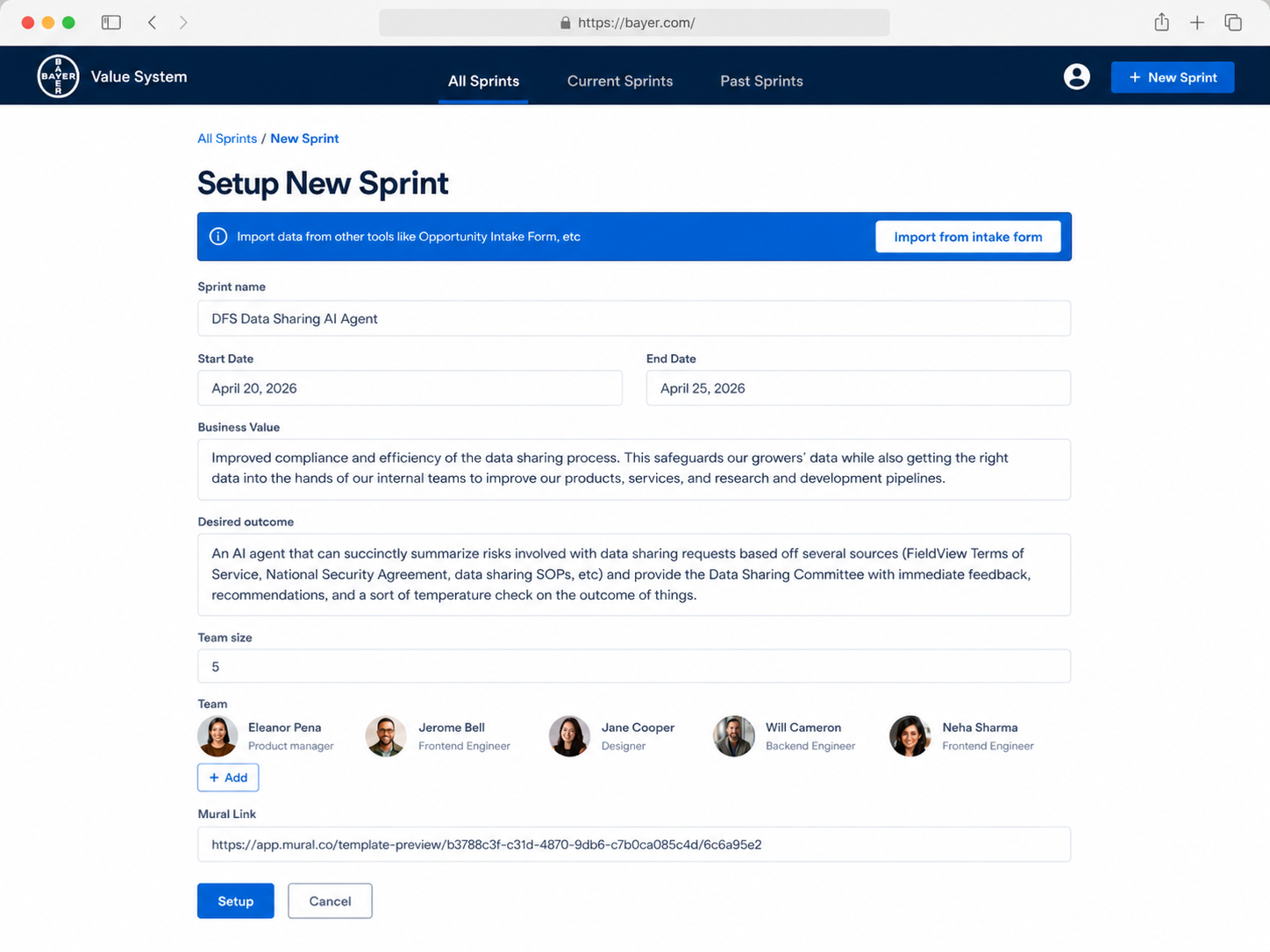
The facilitator captures the sprint's investment baseline — team size, roles, cost, business value, and desired outcome. This gives the system the tangible foundation it needs to measure and compare. Data can be imported directly from the Opportunity Intake Form.
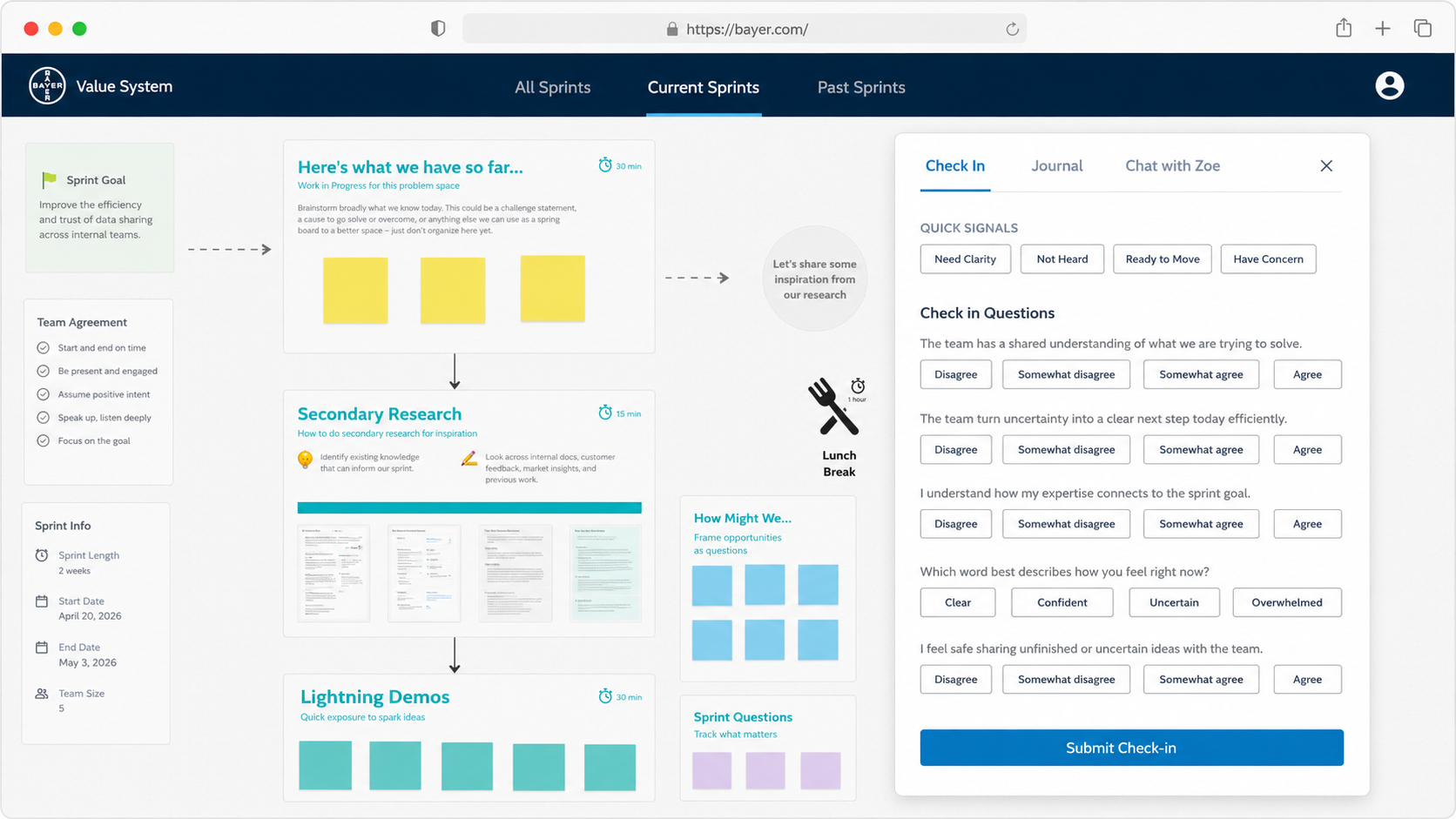
Participants complete lightweight pulse check-ins on Day 1, 3, and 5 — rating clarity, alignment, decision velocity, contribution confidence, and psychological safety. Zoe, Bayer's internal AI assistant, prompts participants with simple anonymous ratings — high, medium, or low — at each check-in point, keeping the data collection lightweight and non-disruptive.
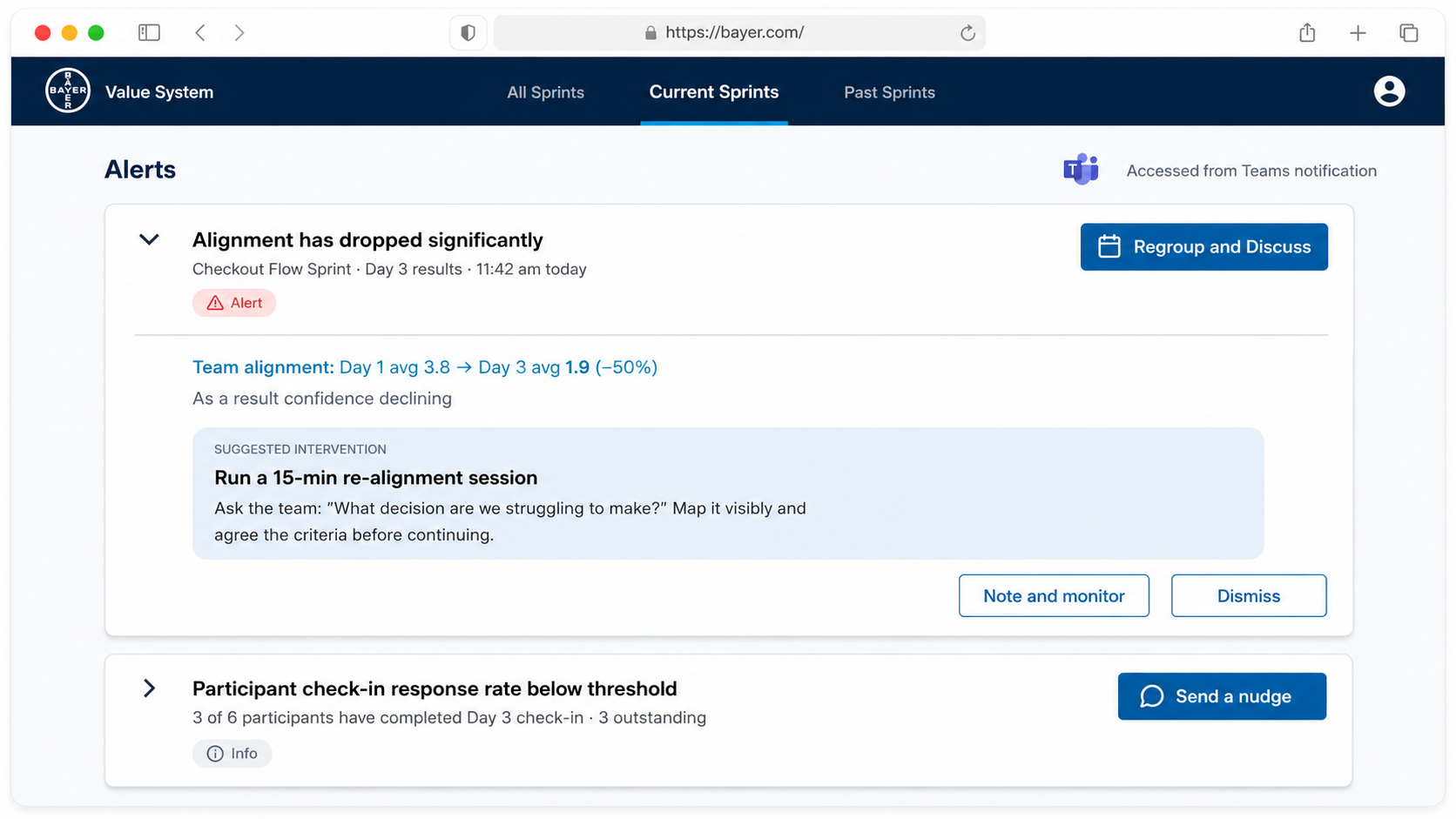
The system continuously evaluates incoming signals against thresholds. When something notable shifts — alignment drops, participation falls below threshold — the facilitator receives a proactive alert with a suggested intervention and next steps.
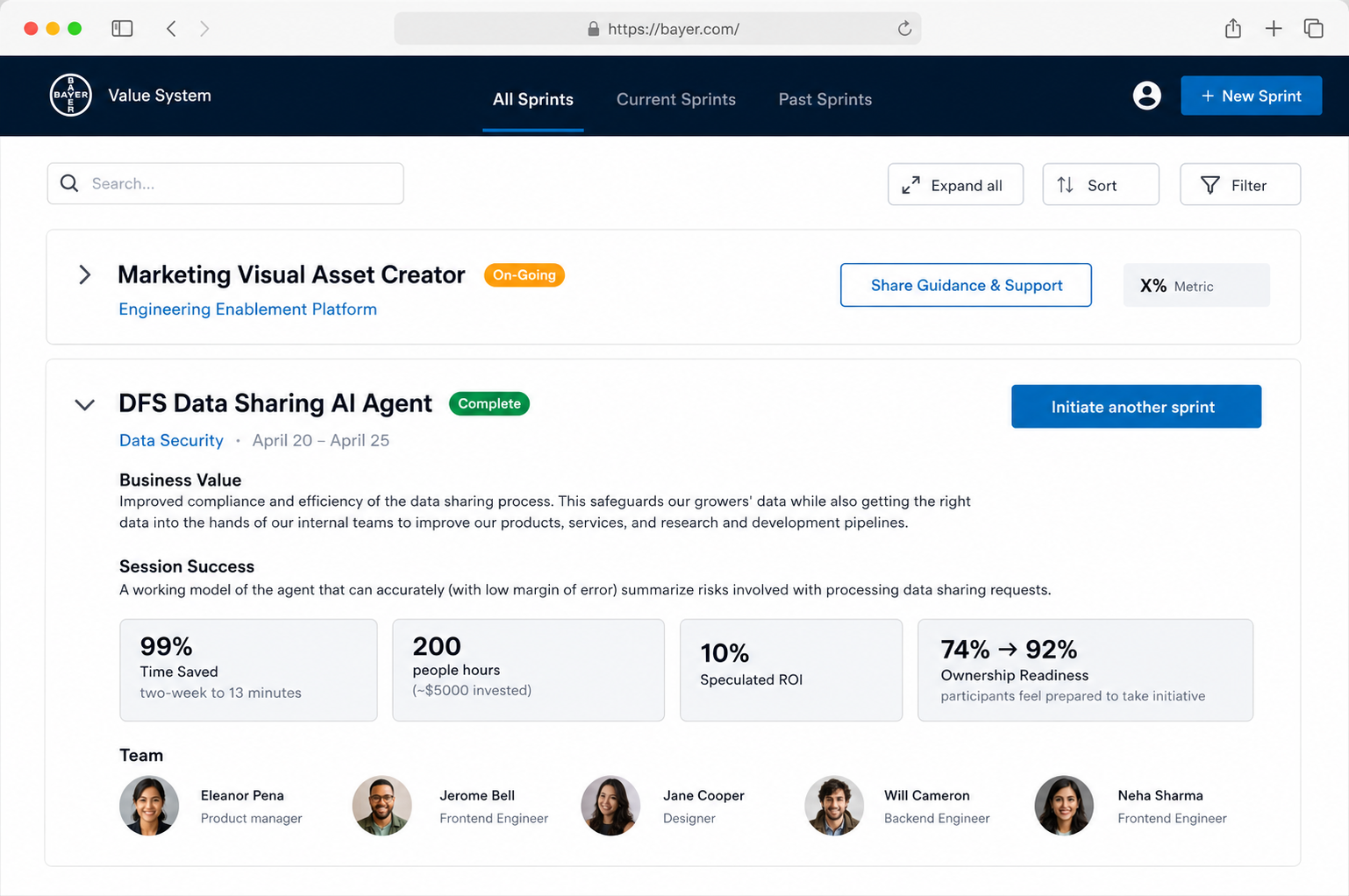
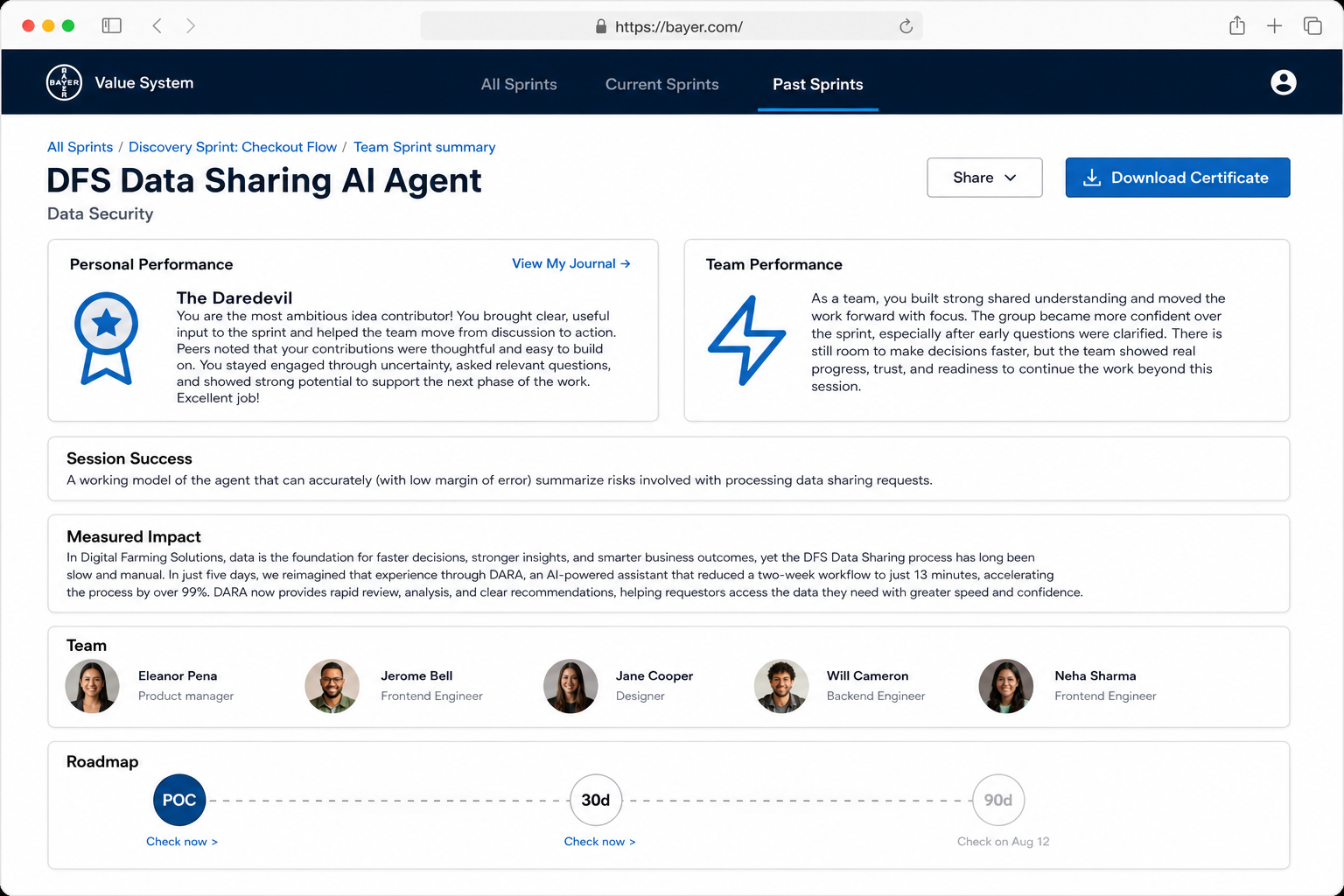
The system aggregates all inputs and synthesizes them into audience-specific views: a personal summary for each Participant, a full sprint record for the Facilitator, and a portfolio-level dashboard for Team Leads — designed for quick scanning, not deep reading.
Dedicated channels deliver the right framing to every audience. LinkedIn-ready certificates issued to every participant. Sprint tags visible in Microsoft Teams profiles. 30 and 90-day update cards keep contributors informed as their sprint moves into implementation.
System in Use
Each screen maps to one of the five core functions — from sprint baseline capture through the synthesized leadership dashboard
Prototype Testing
Four rounds across V1–V4. Moderated think-aloud sessions with Bayer facilitators, participants, and expert stakeholders.
Input modality
Participants strongly preferred conversational check-ins over form surveys. Zoe was integrated as the pulse check-in mechanism directly from this signal.
Alert timing
Mid-sprint alerts felt disruptive. Facilitators preferred a morning review window — and wanted suggested interventions alongside the alert, not just a flag.
Language & standout
"Leadership view" became "Interest Group Summary" to match Bayer's non-hierarchical DSO language. LinkedIn certificates were flagged as the highest personal-value feature.
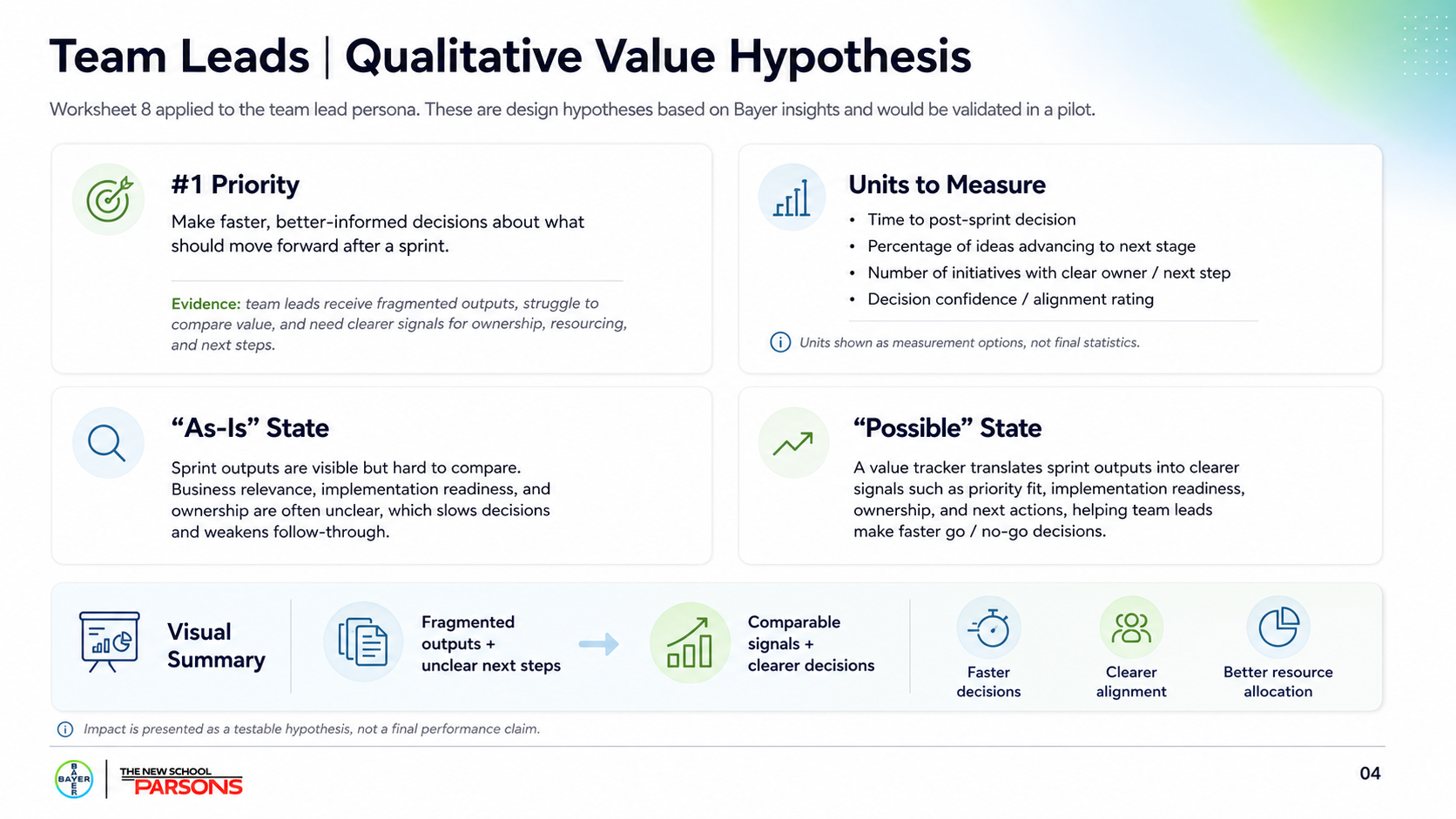
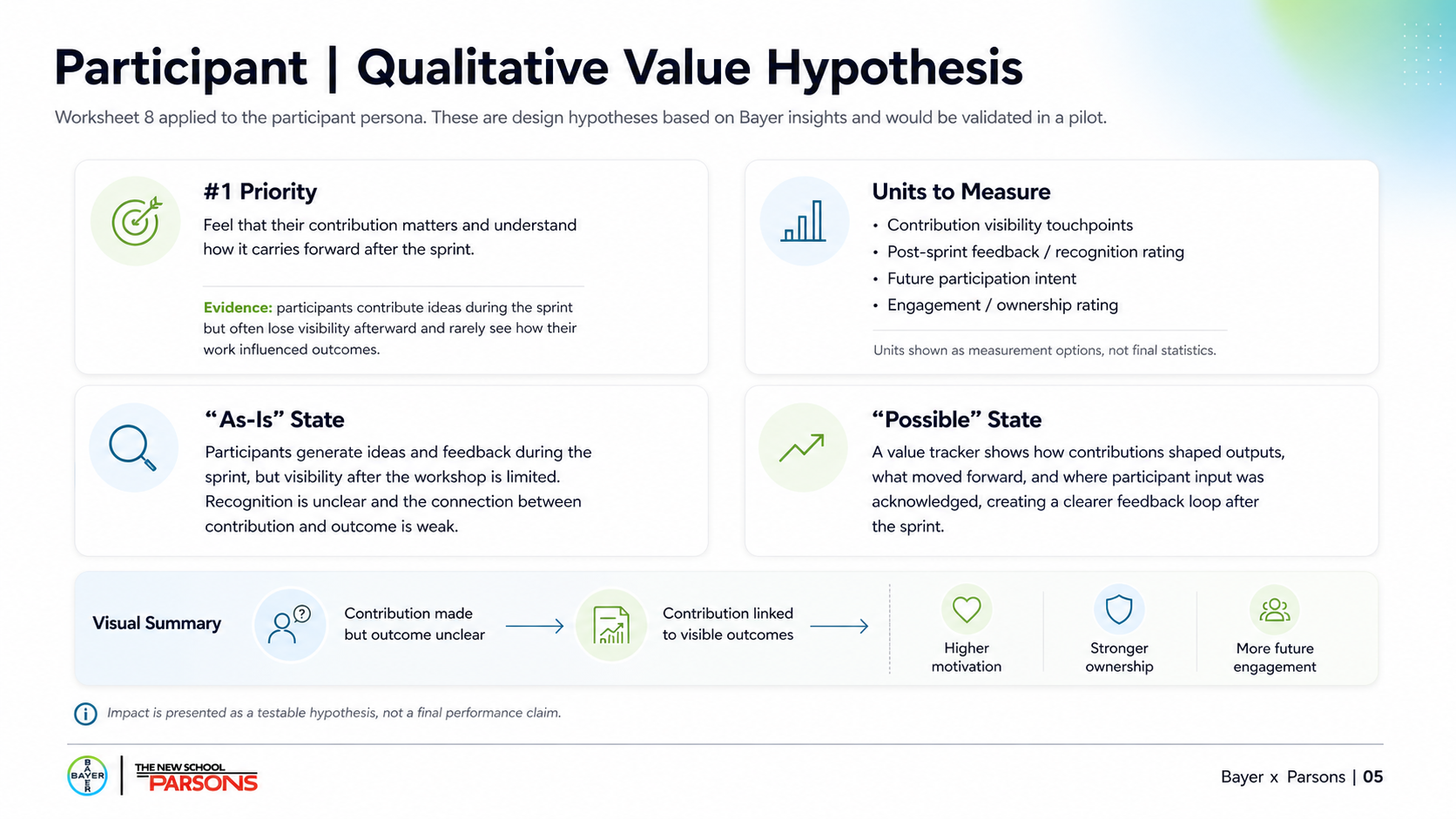
Projected Value by Stakeholder
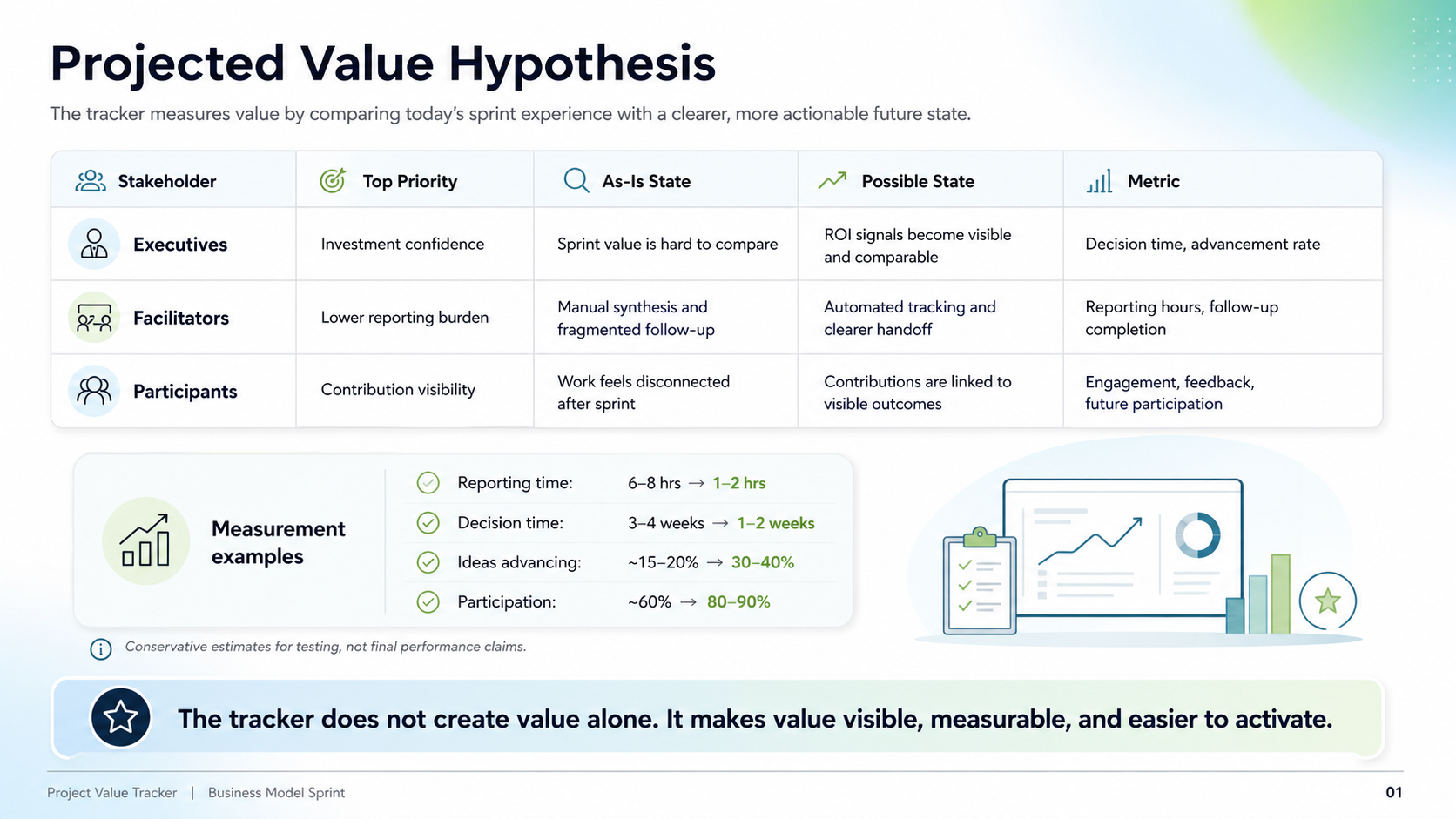
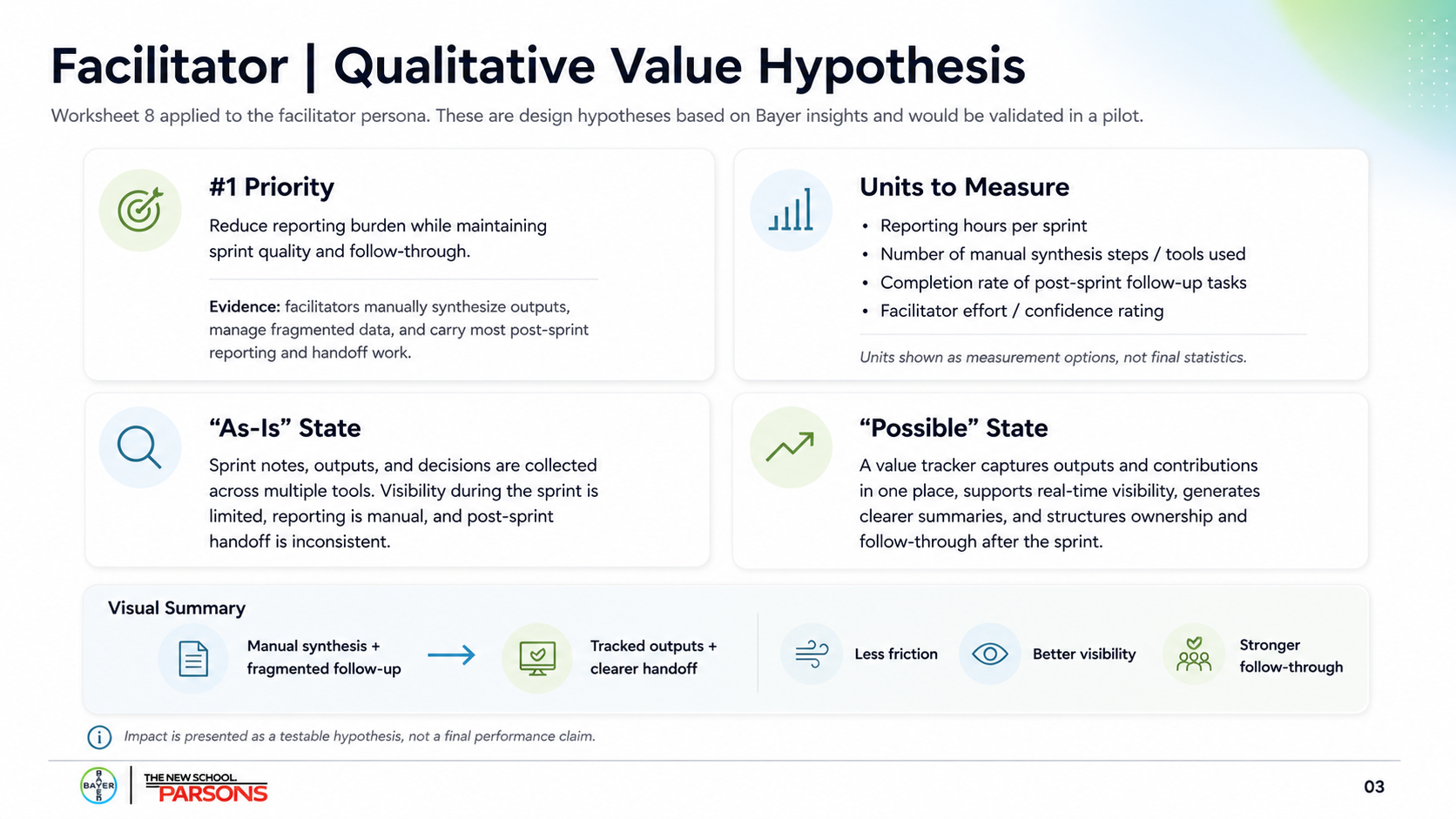
Qualitative hypotheses grounded in Bayer insights. Each persona has a distinct priority, as-is state, and possible state that the Value System targets.
Value needs its own system.
The sprint itself was never the problem. What Bayer needed was a way to carry what happened in those five days forward, into a form leadership could trust, facilitators could act on, and participants could point to. That's the shift this project makes: from a single event to a system that keeps generating evidence long after the sprint ends.
Next Project
Hypnos® →